
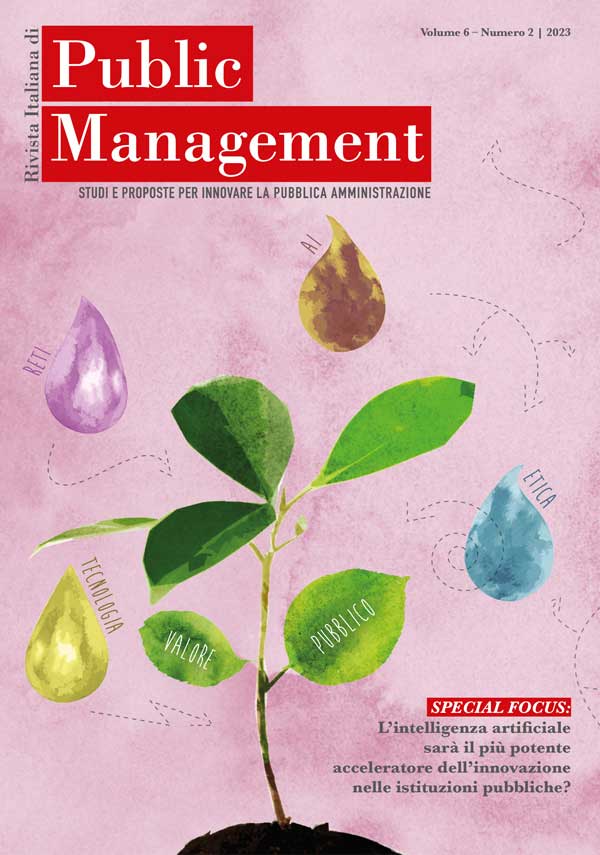
Volume 6 – Number 2 – 2023
December 23, 2025
Volume 6 - Number 2 - 2023
December 23, 2025
SPECIAL FOCUS
Will artificial intelligence be the most powerful accelerator of innovation in public institutions?December 23, 2025
di Emanuela Lombardo - Regione Lombardia
The modus operandi of the public administration is changing considerably, and it is likely that in a few years’ time the architecture of administrative service delivery will have a predominantly digital footprint, marked also by the use of technologies such as artificial intelligence (Ai).
The modus operandi of the public administration is changing considerably, and it is likely that in a few years’ time the architecture of administrative service delivery will have a predominantly digital footprint, marked also by the use of technologies such as artificial intelligence (Ai).
Do you like it?
December 23, 2025
di Michela Giachetti Fantini - Enea – Agenzia per le nuove tecnologie, l’energia e lo sviluppo economico sostenibile
The paper analyses the innovations introduced by the article 30 of Legislative Decree 36/2023, concerning the application of automated procedures in the life cycle of public contracts, through technological solutions, including the Artificial Intelligence, evaluating the effects on the italian administrative system and the future perspectives.
The paper analyses the innovations introduced by the article 30 of Legislative Decree 36/2023, concerning the application of automated procedures in the life cycle of public contracts, through technological solutions, including the Artificial Intelligence, evaluating the effects on the italian administrative system and the future perspectives.
Do you like it?
DIALOGUES
December 23, 2025
di Mariella Stella - Corso di Dottorato di Ricerca di Interesse nazionale in Risorse per la Pa: persone e dati (XXXIX ciclo) – Università degli Studi di Milano – Bicocca
What training challenges lie ahead for local public administration? How can public employees change their social impact, improve the effectiveness and efficiency of services, and build a new alliance with citizens and the Third Sector? Social innovation could be the answer, but only if it can be integrated systematically into public administration.
What training challenges lie ahead for local public administration? How can public employees change their social impact, improve the effectiveness and efficiency of services, and build a new alliance with citizens and the Third Sector? Social innovation could be the answer, but only if it can be integrated systematically into public administration.
Do you like it?
December 23, 2025
di Caterina Cossiga - Master interateneo in Diritto amministrativo (MIDA) – Sapienza Università di Roma e Master of Studies –European Public Law Organization (EPLO)
The paper traces the evolution of strategic planning for human resources within public administrations, highlighting the persistent challenges associated with implementing effective personnel planning mechanisms.
The paper traces the evolution of strategic planning for human resources within public administrations, highlighting the persistent challenges associated with implementing effective personnel planning mechanisms.
Do you like it?
December 23, 2025
di Daniele Bruschi - Master in Management e Innovazione delle pubbliche amministrazioni centrali (MIPAC) – ALTIS Graduate
School of Sustainable Management
Following the intense competition for funding for research and innovation and the increasing size and complexity of the funded projects, a new professional figure has emerged, both internationally and in Italy: the Research Manager and Administrator (Rma).
Following the intense competition for funding for research and innovation and the increasing size and complexity of the funded projects, a new professional figure has emerged, both internationally and in Italy: the Research Manager and Administrator (Rma).
Do you like it?
December 23, 2025
di Massimiliano Gambardella - Head of University Relation, PagoPa Adjunct Professor di Economia del Lavoro e innovazione digitale, Università degli Studi di Napoli Parthenope
Cristiano Zagari - Head of European and International Affairs, PagoPa Docente FiveG Academy – Università degli Studi di Napoli Federico II
For years, experts in European institutions have argued that crises often serve as catalysts for the evolution of European policies and institutions. The Covid-19 pandemic posed unprecedented challenges to the European union (Eu), restricting free movement and physical interactions, while revealing the importance of digital tools and infrastructures.
Cristiano Zagari - Head of European and International Affairs, PagoPa Docente FiveG Academy – Università degli Studi di Napoli Federico II
For years, experts in European institutions have argued that crises often serve as catalysts for the evolution of European policies and institutions. The Covid-19 pandemic posed unprecedented challenges to the European union (Eu), restricting free movement and physical interactions, while revealing the importance of digital tools and infrastructures.
Do you like it?